Wednesday, January 22, 2020

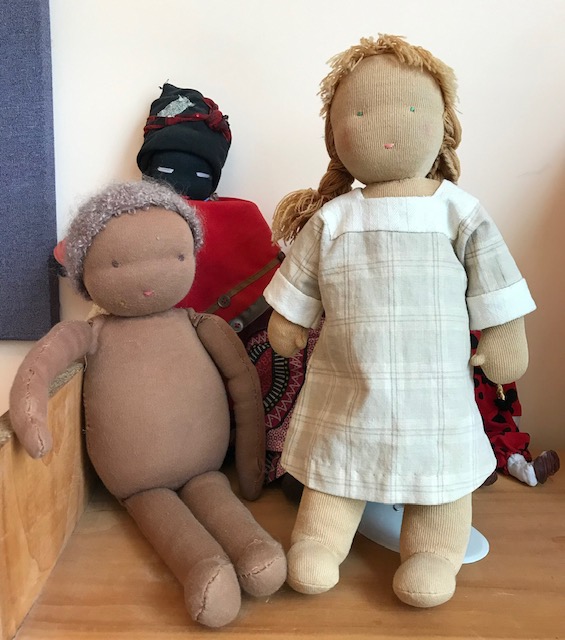
Waldorf dolls

Louise Spear, long-time Hartsbrook handwork teacher, will be giving a 3-session workshop on making Waldorf dolls, which is also taught in middle-school handwork classes.

When: Thursdays 8:30-10:30am February 13, 27, and March 5, 11Where: Hartsbrook Handwork room
Cost: Lessons are free to the community, materials and supplies estimated $15-20

RSVP BY WEDNESDAY, JANUARY 29, 2020 to join group order for doll fabric and stuffing materials. You may respond after that date and still participate in doll making if you have your own materials.


Materials:
= Special doll fabric (group order to save on shipping, specify color)
= Stuffing and tubular gauze (group order for bulk stuffing)

Supplies to bring: Needles, thread, embroidery floss, hair (yarn)

In the first session we will create the inner head and torso and add the skin fabric to the head and sew this down, as well as do facial features if we have time. The last step could be done at home once everyone has an idea of what to do.

In the second session, we can create patterns and cut out the body and arm pieces. These then need to be sewn before we can stuff and attach to the body.

As most of the crafters can probably crochet, starting a wig for the doll can happen anytime after we have made the heads. I have always sewn on hair at the end but it could be done earlier by careful adults.

In the third session, we would stuff the body pieces and sew them all together. Fast workers could also work on hair or clothing but these last two items could be done at home.


Tuesday, December 31, 2019

Friday, November 8, 2019

Felted wool slippers

December 5 & 12, 2019 
8:30-10:45am
Handwork Room

Experienced felt artist Karen Lavalee-Tente will lead this workshop to make felted wool slippers over two weeks. 

RSVP is needed for planning and preparation, including support for gathering materials and equipment. The workshop is free.

Please reserve your space here: https://forms.gle/Hu5CxGeKhVcJqBUq8

RSVP by Friday 11/22/19


To bring:
Your feet for tracing (or a tracing of the feet the slipper is for)
Dishpan
Dish soap 
Towels - many (one a large bath towel)
Plastic bag
Tulle, if you have some (or sheer old curtain; square yard)

To buy:
Wool roving/batt (210-290g total: divided between 2 colors for inside/outside. Try soft merino wool for inside color and wool batt for the outside). 
We will organize a group order and/or field trip to Woolology in Deerfield. 


Saturday, August 17, 2019

Welcome 2019-20

Welcome all crafters--those who want to learn, those with lots of expertise, those with large mending piles, those who want to knit because it is in their children's curriculum...

No experience required to participate in Hartsbrook Community Crafting: an opportunity to get together with other members of the Hartsbrook community and do handwork. Sometimes we all are learning a new craft, sometimes everyone is working on a different personal project, and sometimes we all work together to make something.

Join us Thursday, September 5, 2019 to finish a yo-yo quilt we started in the Spring to raffle at the Farm2Table event on September 21st. Most likely we will be set up under the canopy outside the main entrance of the green Hartsbrook Hall building, and newcomers are welcome to join in after the orientation program. We will also be selling raffle tickets for the quilt! $5.

Community Crafting gathers on Thursday mornings from 8:30-10:30am in the handwork room, upstairs in Hartsbrook Hall.

Friday, June 14, 2019

Yo-yo quilt 2019


This year we decided to make a yo-yo quilt as our group project for a fundraiser. We learned how to make the fabric yo-yos during Thursday morning community crafting sessions, and then a few nimble-fingered parents and grandparents hand-stitched hundreds of them at home or on the go. (You can carry them with you and make them when you have a few free minutes!) Karen has gathered all the yo-yo squares that everyone made, she and Kelly laid them out in a pleasing pattern, and Karen and her mother will sew them into a quilt, ready for the raffle drawing in September! Tickets are available now.

We will be raffling off this quilt in September to benefit Hartsbrook!

The ruched fabric rosette known as a yo-yo in North America and a Suffolk Puff in the British Isles and elsewhere is a curious little thing.

A yo-yo is produced by forming a fold on the edge of a fabric circle with a running stitch, and then pulling the thread to form a gathered round. It can then be combined with others to produce an “open-weave” quilt top, or used singly as an embellishment for three-dimensional appliqué.

It is one of those novelty techniques that’although closely associated with quilts—does not of itself produce a true quilt. Many yo-yo “quilts” have no batting or backing, and are more like coverlets or throws. Even those that are attached to a backing are usually tied rather than quilted. Nevertheless, quilters love yo-yos.

Most commonly associated with the 1930s and ‘40s, yo-yo quilts of that era frequently mimic hexagon mosaic patterns popular at the time [see our granny hexagon blanket project 2018], such as Grandmother’s Flower Garden. Yo-yos were also used to create remarkable pictorial quilts, such as Texas Under Six Flags created by Leila Chaney in 1936 (pictured), which features over 10,000 silk yo-yos of varying sizes.
(continues, click link to see full article)  
The Yo-Yo quilt was a popular style of quilt making in America from the 1920-40s. Yo-Yos, or tiny circles of fabric, were gathered up at the edges and sewn together to create a three-dimensional effect. Yo-Yo quilts were popular because women could carry the little circles of fabric with them and make Yo-Yos whenever they had a free moment. Another way to explain the popularity of the Yo-Yo quilt may be its association with the toy called the Yo-Yo, very popular in the 1930-40s. There are many theories or ideas about how long the Yo-Yo has been in existence. But we know that a wooden toy with a string looped around the center axis was developed in the Philippines over 100 years ago. Some people believe that the Yo-Yo comes from the Filipino word for “come-come” or “return”. In the 1920s a man named Pedro Flores brought a Filipino Yo-Yo to the United States. A businessman named Donald Duncan bought the Filipino Yo-Yo Company around 1928. In 1932 Mr. Duncan received a trademark for the word Yo-Yo.
Source: https://museums.alaska.gov/QuiltExhibit/quiltspdf/YoYo.pdf

"Yo-yo quilts were popular in the 1930s and 1940s, and we see lots of lovely examples sewn with fabrics from those eras. Some were structured, with the rosettes arranged to form a pattern, but many of the examples are scrap quilts."
 - The Spruce Crafts blog

Internet resources:
https://www.thesprucecrafts.com/how-to-make-a-yo-yo-quilt-2821444
https://www.guidepatterns.com/how-to-make-a-yo-yo-quilt-super-cool-instructions.php
https://www.quilts.com/sfancy/suzy-s-fancy-the-story-of-fabric-yo-yos.html
A Pinterest board of yo-yo quilts: https://www.pinterest.com/purplebug61/yo-yo-quilt/?lp=true


Basic instructions with our real quilt start.

Sunday, May 12, 2019

Crafting activity history

2018-19
2017-18